
Abstract: Titanate Nanotubes Powder is attracting increasing attention in advanced materials research because its nanotube morphology combines a high specific surface area, surface reactivity, photocatalytic activity, ion-exchange capability, and useful electrochemical properties. According to SAT NANO, its Titanate Nanotubes Powder is supplied with 99% purity, a 10–30 nm diameter, a length greater than 1 μm, and a specific surface area of 200–300 m²/g. These characteristics make it a promising material for solar cells, catalysts, sensors, energy storage, environmental technologies, and other high-performance applications.
Titanate Nanotubes Powder is a one-dimensional nanostructured material characterized by a tubular morphology and a high surface-to-volume ratio. Unlike conventional bulk titanium-based materials, nanotube structures can expose substantially more active surface area, which can improve interactions with light, chemical species, ions, and surrounding materials.
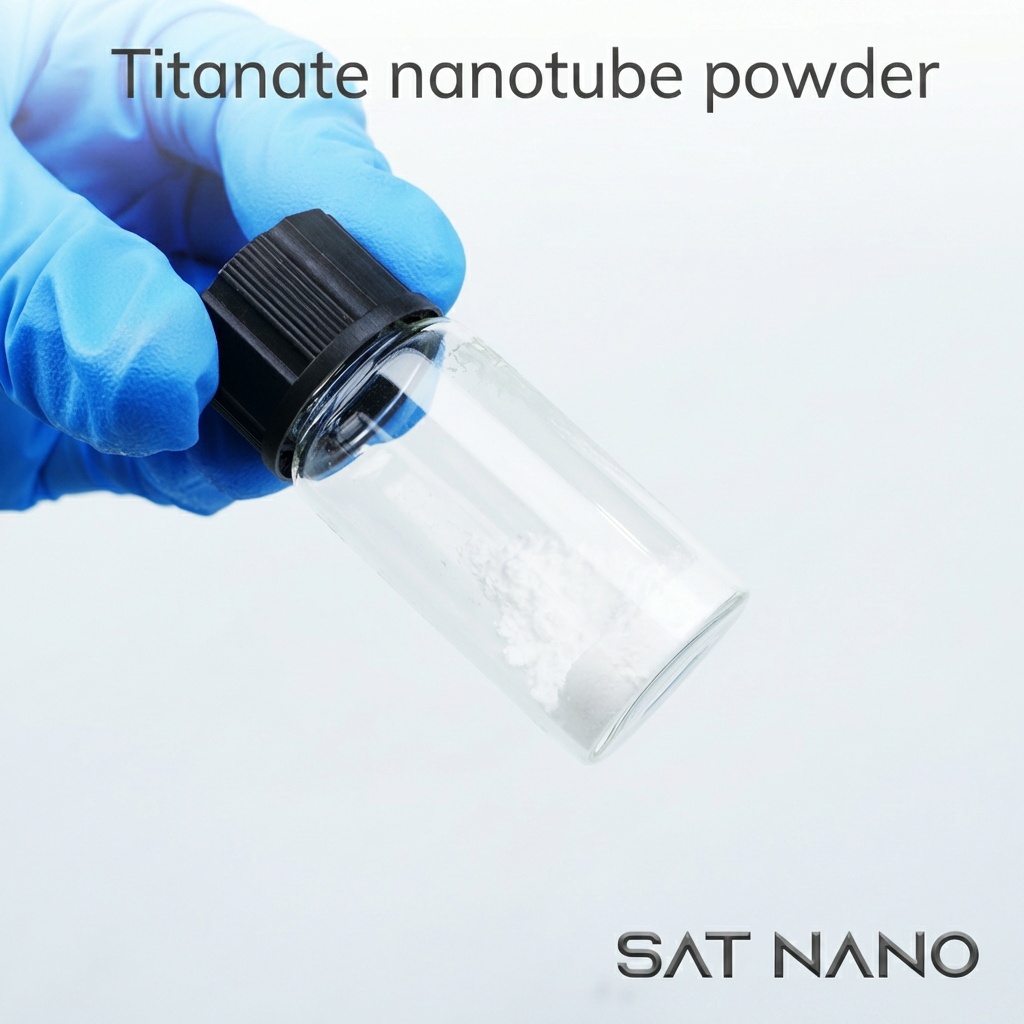
The Titanate Nanotubes Powder supplied by SAT NANO is identified by product code SAT-TIO2TNT. The published specifications include 99% purity, a diameter of 10–30 nm, a length greater than 1 μm, a specific surface area of 200–300 m²/g, and a white powder appearance. SAT NANO also states that this product is supplied with a one-year warranty and has customers in more than 30 countries.
These characteristics make the material particularly interesting for researchers, engineers, and industrial buyers looking for nanostructured titanium-based materials with high surface activity and multifunctional performance.
For advanced nanomaterial procurement, specifications are more important than simply selecting a material based on its name. Particle dimensions, purity, morphology, and specific surface area can directly influence processing behavior and final application performance.
| Parameter | SAT NANO Specification | Why It Matters |
|---|---|---|
| Product Code | SAT-TIO2TNT | Helps identify the specific material grade during purchasing and technical communication. |
| Purity | 99% | High purity can support consistent performance in research and advanced material formulations. |
| Diameter | 10–30 nm | Controls nanoscale morphology and contributes to high surface-area characteristics. |
| Length | >1 μm | Supports the formation of a distinctive one-dimensional nanotube structure. |
| Specific Surface Area | 200–300 m²/g | Provides extensive active surface for catalysis, adsorption, electrochemical reactions, and sensing. |
| Appearance | White powder | Provides a convenient physical form for formulation, laboratory preparation, and material processing. |
When comparing suppliers, buyers should evaluate the complete specification sheet rather than focusing on particle size alone. Consistency between batches, purity, morphology, surface area, packaging, and technical support can all influence the total value of a nanomaterial purchase.
The performance potential of Titanate Nanotubes Powder comes from the combination of nanoscale dimensions and its tubular architecture. SAT NANO identifies several properties that can support advanced applications.
A specific surface area of 200–300 m²/g provides a large interface between the nanotubes and their surrounding environment. This is particularly valuable when surface reactions, adsorption, or charge-transfer processes are important.
Titanate nanotubes can participate in photocatalytic and electrocatalytic processes. Potential uses include organic pollutant degradation and water-splitting research for hydrogen production. The combination of nanoscale morphology and active surface sites makes the material attractive for energy and environmental research.
Ion-exchange properties expand the material's potential beyond conventional photocatalysis. Titanate nanotube structures can be investigated in ion-exchange membranes, adsorption systems, and separation technologies where interaction with ionic species is essential.
The nanotube structure can provide a larger interaction area with incident light and facilitate charge-transfer processes. This makes Titanate Nanotubes Powder a candidate material for optoelectronic and photovoltaic research.
When assembled into suitable structures, titanate nanotubes can provide high porosity and useful mechanical characteristics. Such structures may be valuable in separation, adsorption, and catalytic systems where both permeability and surface activity matter.
The combination of high surface area, photocatalytic behavior, ion exchange, and electrochemical functionality allows Titanate Nanotubes Powder to serve multiple research and industrial purposes.
Application suitability should always be validated through application-specific testing. A material that performs well in a laboratory formulation may require optimization before it can be incorporated into a commercial device or industrial process.
| Application | Relevant Property | Potential Function |
|---|---|---|
| Solar Cells | Light interaction and electron transfer | Photoelectric conversion research |
| Catalysis | High surface area and surface reactivity | Accelerating or supporting catalytic reactions |
| Gas Sensors | Large active surface | Interaction with target gas molecules |
| Supercapacitors | Porosity and electrochemical activity | Energy-storage material research |
| Environmental Treatment | Photocatalytic activity | Organic pollutant degradation research |
| Ion-Exchange Systems | Ion-exchange capability | Adsorption and separation applications |
For laboratories, universities, R&D centers, and industrial manufacturers, selecting the right nanotube powder requires a technical evaluation rather than a simple price comparison. Consider the following factors before placing an order:
Working with an experienced China nanomaterial manufacturer and supplier can simplify specification confirmation, product selection, technical communication, and international purchasing. SAT NANO positions itself as a large-scale manufacturer and supplier of Titanate Nanotubes Powder and states that its products are supplied to customers in more than 30 countries.
It can be used or investigated in solar cells, catalysts, gas and photosensitive sensors, energy-storage materials, environmental treatment, ion-exchange systems, hydrogen-production research, and selected biomedical applications.
The published specification lists a purity of 99% for product SAT-TIO2TNT.
The published diameter range is 10–30 nm, while the specified nanotube length is greater than 1 μm.
SAT NANO lists a specific surface area of 200–300 m²/g. This high surface area is one of the key characteristics supporting catalytic, adsorption, sensing, and electrochemical applications.
Buyers can send their specifications and requirements to SAT NANO for product and order confirmation. The supplier states that payment can be made by bank transfer, credit card, or PayPal, with international shipping options including FedEx, UPS, and DHL.
Titanate Nanotubes Powder combines nanoscale dimensions, a tubular structure, high specific surface area, photocatalytic and electrochemical activity, ion-exchange capability, and potential light-energy conversion performance. With a published purity of 99%, 10–30 nm diameter, length above 1 μm, and 200–300 m²/g specific surface area, the SAT-TIO2TNT grade provides a well-defined starting point for advanced material research and application development. Whether you are developing catalysts, sensors, solar-cell materials, environmental technologies, or energy-storage systems, choosing a supplier that can provide clear specifications and dependable technical support is essential. For detailed specifications, pricing, customization requirements, or bulk procurement of Titanate Nanotubes Powder, contact us at SAT NANO to discuss your application and sourcing requirements.