
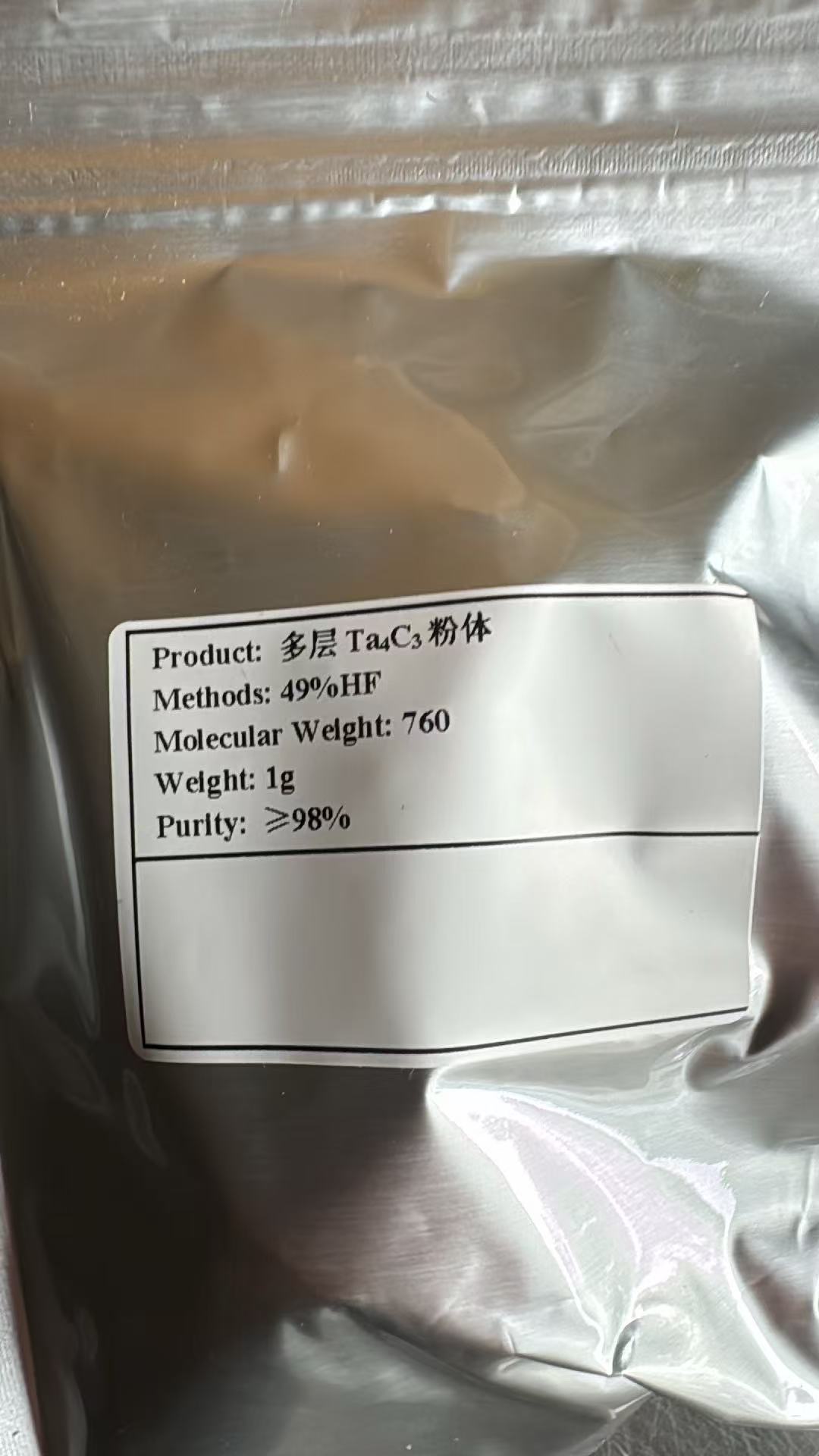
In June 2026, SAT NANO received an unassuming order: a materials science research institute in Shenzhen needed 1 gram of multilayer Ta₄C₃ MXene powder.
One gram — less than the weight of a paperclip. Yet within SAT NANO, such orders trigger a meticulous chain: tracing the synthesis records of the MAX phase precursor, verifying acid etching parameters, confirming crystal phase via XRD, inspecting morphology under SEM, then vacuum-sealing the powder under inert gas before dispatch.
For a company that has spent over a decade refining nanopowder production, this was just another routine order. But through the lens of the 2D materials industry, that single gram carries far greater weight — it marks a decisive shift in China's MXene supply chain from "lab self-sufficiency" to "standardized commercial supply."
In 2011, Yury Gogotsi's team at Drexel University first reported the synthesis of Ti₃C₂Tₓ MXene. Fifteen years later, the MXene family has expanded to over 30 experimentally synthesized members, including Ta₄C₃, Nb₂C, V₂C, Mo₂TiC₂, and more than 100 theoretically predicted variants.
Compared to graphene, MXenes offer several critical differentiators:
|
Dimension |
Graphene |
MXene (Ta₄C₃ as example) |
|
Electrical Conductivity |
~10,000 S/cm |
8,000–12,000 S/cm (multilayer) |
|
Surface Chemistry |
Inert; requires functionalization |
Intrinsically rich terminations (-F, -O, -OH); naturally hydrophilic |
|
Interlayer Spacing Tunability |
Limited |
Broadly tunable via intercalation (TMAOH, DMSO, etc.) |
|
Synthesis Complexity |
Scalability challenges persist |
Mature MAX-phase etching pathway; wide process window |
|
Dispersibility |
Requires surfactant assistance |
Directly dispersible in water and polar solvents |

The Shenzhen institute has deep expertise in 2D materials. Its research group possesses a complete MXene preparation workflow — from Ta₄AlC₃ MAX phase synthesis to HF etching to intercalation and delamination. The technical pathway is well within their capability.
But they faced a practical question: as the research enters deeper waters, can self-prepared materials withstand the scrutiny of peer review?
Is the carbothermal reduction of MAX phase precursors consistent from batch to batch?
Is aluminum layer removal during etching truly complete?
Are the ratios of surface terminations (-F / -O / -OH) comparable to values reported in the literature?
Can XRD patterns, SEM images, and XPS spectra form a complete data traceability chain across every batch?
For research groups preparing high-impact journal submissions, the batch-to-batch uncertainty of "homemade" materials has become a hidden risk that can erode reviewer confidence.This is precisely why they chose SAT NANO: the need for standardized MXene materials from a professional supplier, complete with full characterization reports — rather than reliance on non-standard in-group preparation.
Every batch of Ta₄C₃ MXene powder delivered includes the following characterization data:
|
Test Item |
Method |
Acceptance Criterion |
|
Phase Identification |
XRD (Cu Kα, 2θ = 5°–90°) |
Disappearance of Ta₄AlC₃ (002) peak; emergence of MXene-characteristic (002) peak shifted to lower angle |
|
Morphology |
SEM |
Clear multilayer accordion-like structure; no evidence of over-etching or structural collapse |
|
Elemental Composition |
EDS |
Ta:C atomic ratio close to 4:3; residual Al < 1 at% |
|
Surface Terminations |
XPS |
Peak deconvolution of Ta 4f, C 1s, O 1s, F 1s; quantitative surface termination ratios |
|
Particle Size Distribution |
DLS |
D50 within client-specified range |
|
Purity |
ICP-OES |
≥ 99%, with individual impurity elements listed |
Whether your research group is in the exploratory phase of MXene studies or seeking a scalable 2D materials supplier, SAT NANO can provide a tailored solution:
Website: www.satnanomaterial.com
Email: admin@satnano.com
Phone / WhatsApp: +86 13929258449
Address: Xiaqiao Industry, Dongcheng District, Dongguan, Guangdong, China