
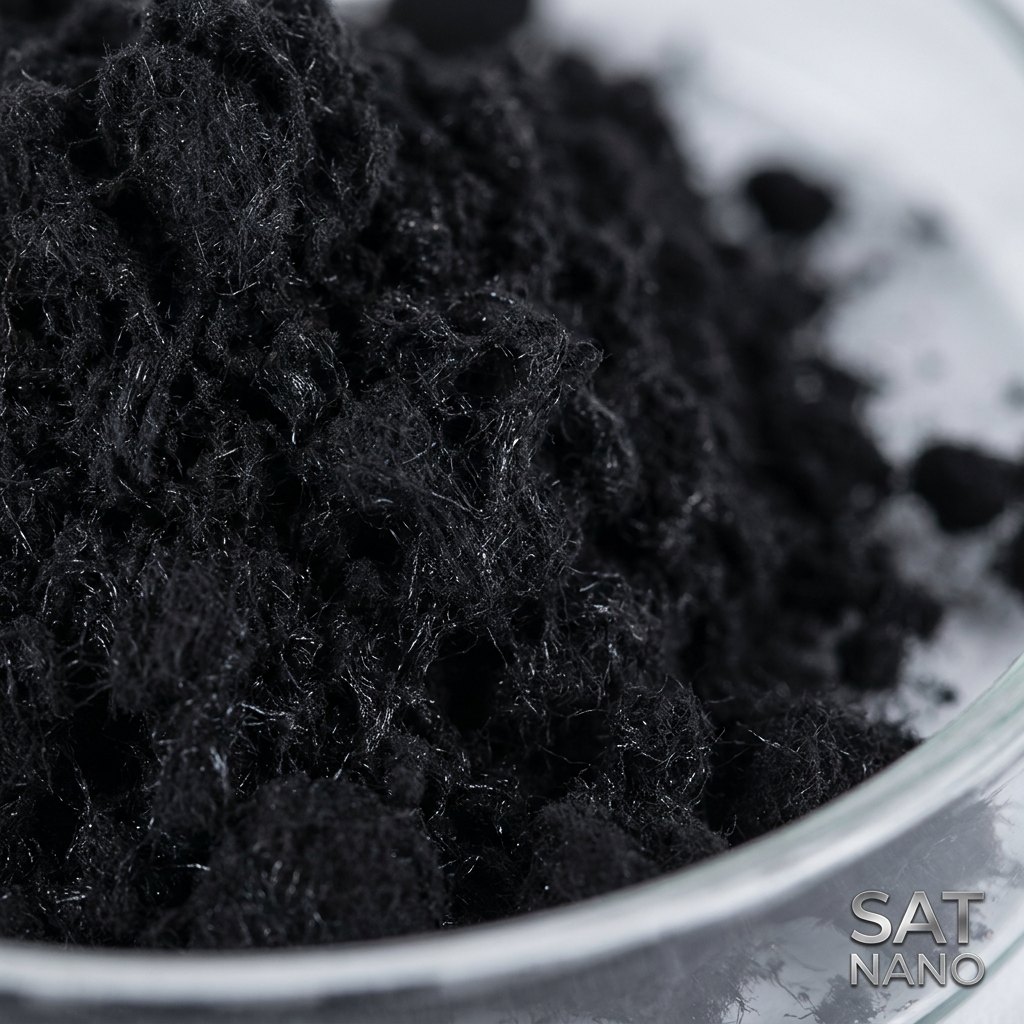
Nitrogen-doped Carbon Nanotube (N-CNT) Powder is a high-performance nanomaterial created by chemically integrating nitrogen atoms into the hexagonal carbon lattice of carbon nanotubes (CNTs). This modification alters the electronic structure and surface chemistry, making N-CNTs superior to regular CNTs in terms of conductivity, chemical reactivity, and dispersibility.
When nitrogen atoms (5 valence electrons) replace carbon atoms (4 valence electrons), they typically form three types of bonding structures:
Pyridinic N: Located at the edges or defect sites, bonded to two carbon atoms. It provides a lone pair of electrons, significantly enhancing electrocatalytic activity.
Pyrrolic N: Integrated into five-membered rings, increasing the surface polarity and chemical reactivity.
Graphitic (Quaternary) N: Replaces a carbon atom within the hexagonal plane. It contributes an extra electron to the ππ system, greatly improving n-type electrical conductivity.
Morphology: Under TEM (Transmission Electron Microscopy), N-CNTs often exhibit a unique "bamboo-like" structure, characterized by periodic internal caps, which distinguishes them from the smooth, hollow cylinders of regular CNTs.
Enhanced Conductivity: Nitrogen acts as an n-type donor, increasing the charge carrier density. This leads to lower bulk resistivity compared to undoped multi-walled CNTs.
Superior Dispersibility: The introduction of nitrogen atoms creates dipole moments on the surface, making the nanotubes more polar. This improves wettability and stability in polar solvents such as Water, Ethanol, and NMP.
Metal-Free Catalytic Activity: N-CNTs serve as excellent electrocatalysts for the Oxygen Reduction Reaction (ORR) in fuel cells, offering a potential low-cost alternative to expensive Platinum (Pt) catalysts.
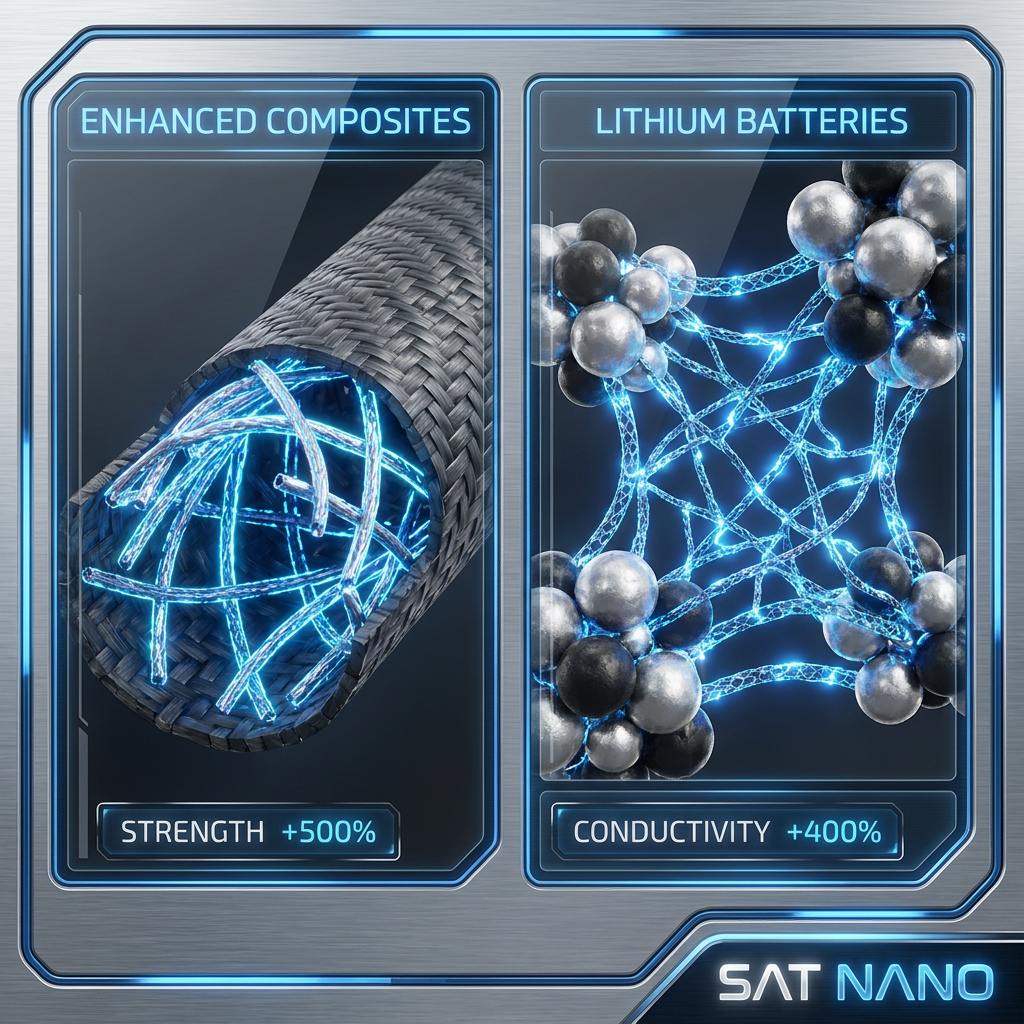
Stronger Interfacial Bonding: In polymer composites, the nitrogen functional groups provide better mechanical interlocking and chemical bonding with the matrix.
Their most fundamental difference lies in the alteration of electronic structure and the introduction of surface polarity. In actual powder parameter comparisons, small differences at the chemical level can lead to significant changes in physical properties.
The following is a comparison of key parameters between nitrogen doped carbon nanotube powder and ordinary carbon nanotube powder:
|
Parameter / Dimension |
Regular Carbon Nanotubes (CNTs) |
Nitrogen-doped Carbon Nanotubes (N-CNTs) |
Reason for Difference |
|
Chemical Composition |
Carbon content ≈100% |
Nitrogen content 1%∼8%1%∼8% |
Substitution or intercalation of nitrogen atoms in the carbon lattice. |
|
Volume Resistivity |
10−2∼10−1 Ω⋅cm |
10−3∼10−2 Ω⋅cm |
Nitrogen atoms act as donors, providing extra electrons and increasing charge carrier density (n-type doping). |
|
Dispersibility (in Water/NMP) |
Poor; requires high-dose surfactants. |
Significantly Improved; potential for partial self-dispersion. |
Nitrogen introduces dipole moments, increasing surface polarity and hydrophilicity. |
|
Defect Density (ID/IG ratio) |
Lower (more ordered crystalline structure). |
Higher |
Nitrogen atoms cause lattice distortion and structural irregularities. |
|
Specific Surface Area (SSA) |
150∼350 m2/g |
200∼450 m2/g |
Doping usually creates more micropores and corrugated surfaces. |
|
Surface Acidity / Basicity |
Neutral to slightly acidic. |
Basic (Lewis Base) |
Pyridinic and pyrrolic nitrogen sites possess lone pair electrons. |
Lithium-ion Batteries & Supercapacitors: Used as a high-end conductive additive. The nitrogen sites can also provide pseudo-capacitance and facilitate faster ion transport, improving rate performance and cycle life.
Fuel Cells: Acts as a support material for catalysts or as a direct metal-free catalyst for ORR.
Chemical & Biosensors: Highly sensitive to specific gases (CO2, NOX) and biomolecules due to the increased active sites on the tube walls.
Conductive Polymers: Ideal for anti-static (ESD) and EMI shielding materials where low loading and high transparency/stability are required.
Chemical Vapor Deposition (CVD): The most common industrial method, using a mixture of hydrocarbon (e.g., ethylene) and nitrogen sources (e.g., ammonia, pyridine, or ethylenediamine) over metal catalysts.
Post-Synthesis Treatment: Subjecting pre-made CNTs to high-temperature annealing in a nitrogen-rich atmosphere (e.g.,NH3 plasma).
Conclusion: N-CNT powder is a "functionalized" version of traditional carbon nanotubes, bridging the gap between pure structural carbon and active chemical materials. It is the preferred choice when your application requires a balance of high electrical conductivity and excellent liquid-phase dispersion.